Wednesday, January 22, 2014
It's Official: The 2014 Ghana Trip is a GO!
Thirteen VCU OT students, 2 VCU OT professors, and 1 physical therapy instructor will be traveling to Ghana from May 18-31st for our annual study abroad program. We look forward to working with our friends at Sovereign Global Mission, Eugemot Orphanage, and New Horizons Special School as well as hopefully make some new friends along the way. As we prepare for our trip I will continue to update the blog and link to the blogs that our students are required to develop. If anyone would like a copy of the course syllabus or reading list that I use, please feel free to e-mail me at reynoldsse3@vcu.edu

Friday, November 22, 2013
Information and Application for 2014 Study Abroad Course Now Available
The application site for the 2014 course is now open.
There will be an info session on Tuesday (Nov. 26) in the Theater Row Building on the MCV campus from 12-1 pm.
The deadline to complete an application is December 27th, 2013.
Thursday, July 25, 2013
Appropriate Paper Technology (APT)
 |
| APT chair with insert |
 |
| APT Walker |
There are multiple advantages to using APT. First the raw materials such as cardboard are available and free (or very low cost) in Ghana. The tools needed to make the equipment are not expensive; most APT can be made using a kitchen knife. As noted by People Potential (2013) advantages of APT go beyond the lower cost; “the advantages include the versatility as unusual shapes and designs can be made according to the needs of the child, the measurements and the impairment”.
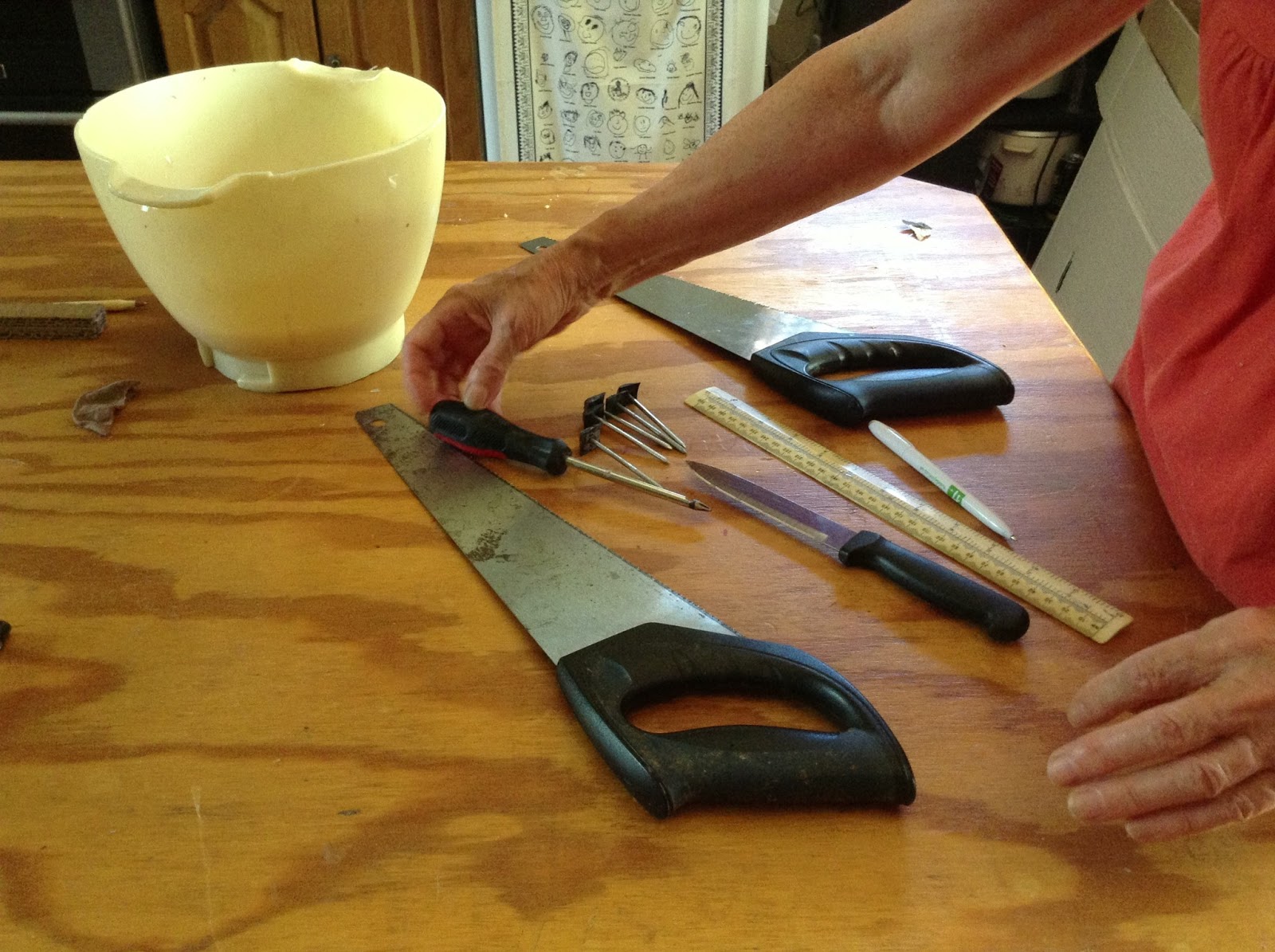 |
| Saw, ruler, knife, roofing nails, bowl |
 |
| Flour and Water make Paste |
Daniel and I took this course together and thoroughly enjoyed our time out on the English countryside with Jean, Ken, Dena, Catherine, and Flynn the dog (also a huge thank you to Richard for building the riding platform for my horse, see pictures below!). While I still need to practice my APT skills (and work on becoming more precise with my measurements no eye-balling allowed!), I feel confident that this new skill set will be put to use soon as I continue to work with children in Ghana and provide learning opportunities for VCU students. Here are a few pictures from our trip:
 |
| Daniel with APT Toy |
 |
| Daniel and Richard- Day 4, Horse has Wheels |
 |
| APT sofa |
 |
| APT double bed I slept in |
 |
| Me with Horse Frame made on Day 2 |
Thursday, July 4, 2013
Tentative Dates for 2014 Study Abroad in Ghana
If you are interested in the 2014 study abroad trip to Ghana and want to block off some dates on your calendar, it looks like we will be traveling the last two weeks in May (May 18-31, 2014). Of course we will not have exact travel dates until much later, but hopefully this helps in planning/scheduling.
Thursday, June 27, 2013
Ghana 2013 Planning Trip- Mission Accomplished!
Thanks to a timely and generous grant from the VCU Global Education Office, I just returned from a 2-week trip to my favorite country of Ghana. The purpose of this trip was to establish or (in many cases) re-establish in-country relationships, identify opportunities for our VCU OT students to complete study-abroad courses, and train a cadre of faculty to lead and co-lead the course in subsequent years. In addition to myself the participants include Dr. Shelly Lane (VCU Professor of Occupational Therapy), Dr. Richard Thorton (Physical Therapist and Adjunct Professor of Occupational Therapy), Dr. Carole Ivey (VCU Assistant Professor of Occupational Therapy), Dr. Jodi Teitelman (Psychologist, Associate Professor of Occupational Therapy), and Kacie Hopkins (VCU OT Alum, Children’s Hospital of Richmond).
In the two weeks we spent in Ghana we visited five centers which were classified as children’s homes, orphanages, or foster homes; these included Osu Children’s home (Accra Region), Nyame Dua foster homes (Teshie, Accra Region), Children’s Home of Hope (Cape Coast), and Eugemot Orphanage (Hohoe, Volta Region). We also visited two schools for children with special needs: The New Horizons School (Accra) and the Gbi School for children with intellectual disabilities (Hohoe). As part of our ongoing work with Sovereign Global Mission we also spent time at the CMB program for “street children” and at the Grace International School in the Adoteiman community.
While our goal was to set up future sites for our students, we also tried to contribute to these centers as much as possible. In addition to bringing donations (in the form of shoes, book bags, school supplies, and medical supplies), we also conducted developmental screenings on children living in the homes/orphanages and provided consultation on positioning, feeding, behavior, and IEP goal writing for staff at some of the schools. The screenings are something we can hope to continue in the future since they can be useful for teachers, caregivers and potential adoptive parents. While most of the children that we screened fell into “average” range, some were identified as “below average” and we were able to make recommendations for those children on site. There was also a clear need for in-services to teachers and caregivers on topics like ergonomics, seating and positioning (e.g. for tasks like feeding or writing), wheel chair repair/configuration, safe transfer techniques for families and caregivers, goal writing and monitoring in special schools, and development of fine motor and problem solving skills for children who do not have opportunities for manipulative play.
As is usually the case in Ghana, the children that we saw were warm, loving, and hopeful despite often coming from or living in disadvantaged situations. Places like Eugemot Orphanage always feel to me like one big family with everyone looking out for each other; it’s like coming home for me in many ways. And as I have been able to see firsthand at Eugemot, orphaned children that have been raised with this type of love and support are capable of growing into successful young men and women who contribute back to the orphanage and the community. Similarly, children who have more obvious physical and intellectual disabilities are well supported at places like the New Horizon School in Accra, where the staff maintains an ongoing commitment to excellence in teaching and rehabilitation. While some of the children there may never be able to fully integrate into regular community life in Accra, they are able to spend their days being productive, learning a trade, earning money and being surrounded by friends and caring staff.
This was an amazing trip and I am so thankful to the Global Education Office (GEO) for this opportunity. I am more excited than ever to show Ghana to our occupational therapy students next year. In addition to the GEO, I would like to acknowledge our Ghanaian friends who helped coordinate this trip and invited us into their homes and schools: Rev. Eric Annan and Felecia Annan of Sovereign Global Mission, Joha, Paul, Muna, and Joe of Eban Project, Mama Eugenia Kahu of Eugemot Orphanage, Vanessa and Jocelyn at New Horizon School, and the best Ghanaian driver ever Vincent. We look forward to seeing you all next May!
Stacey
 |
| Our group at Children's Home of Hope, Cape Coast |
 |
| Kacie, Shelly, Rev. Eric Annan, and me at Grace International School |
 |
| Shelly and Kacie evaluating Master Kofi in Teshie |
 |
| Rick and his new friend at New Horizon School |
As is usually the case in Ghana, the children that we saw were warm, loving, and hopeful despite often coming from or living in disadvantaged situations. Places like Eugemot Orphanage always feel to me like one big family with everyone looking out for each other; it’s like coming home for me in many ways. And as I have been able to see firsthand at Eugemot, orphaned children that have been raised with this type of love and support are capable of growing into successful young men and women who contribute back to the orphanage and the community. Similarly, children who have more obvious physical and intellectual disabilities are well supported at places like the New Horizon School in Accra, where the staff maintains an ongoing commitment to excellence in teaching and rehabilitation. While some of the children there may never be able to fully integrate into regular community life in Accra, they are able to spend their days being productive, learning a trade, earning money and being surrounded by friends and caring staff.
 |
| Children at Eugemot looking at themselves on Jodi's Camera |
 |
| Young adult seamstress at New Horizon School |
This was an amazing trip and I am so thankful to the Global Education Office (GEO) for this opportunity. I am more excited than ever to show Ghana to our occupational therapy students next year. In addition to the GEO, I would like to acknowledge our Ghanaian friends who helped coordinate this trip and invited us into their homes and schools: Rev. Eric Annan and Felecia Annan of Sovereign Global Mission, Joha, Paul, Muna, and Joe of Eban Project, Mama Eugenia Kahu of Eugemot Orphanage, Vanessa and Jocelyn at New Horizon School, and the best Ghanaian driver ever Vincent. We look forward to seeing you all next May!
Stacey
Tuesday, August 23, 2011
Where in the World Have you Been?
So OK. It really looks like I dropped the ball on this whole project, I know. But here's what has been happening since the last post. In February 2010 I was accepted into the NIH K12 career development program for rehabilitation researchers. This amazing opportunity required a 2.5 year move to Gainesville, Florida where I am working with a neuroscientist to study sensory processing disorders in autism. I've been taking classes, running projects, working with students and trying to see just how far I can expand my brain. So...try to not to be too angry that the 2010 Ghana trip was cancelled because lot of good stuff is coming out of this training.
I am going to be Gainesville for one more year and then hopefully back to Virginia Commonwealth University where I will attempt to resume the Ghana OT Study Abroad trip. I have already begun contacting some of friends abroad and looking into how we can get re-connected. Really hoping to do some work at Beacon House and also to get back to the Volta Region. Maybe will write a grant in the mean time to try and get funding for the trip; you know because our economy is in such good shape that they are just handing grants out like candy nowadays (yeah right!). Will post more as things develop.
I am going to be Gainesville for one more year and then hopefully back to Virginia Commonwealth University where I will attempt to resume the Ghana OT Study Abroad trip. I have already begun contacting some of friends abroad and looking into how we can get re-connected. Really hoping to do some work at Beacon House and also to get back to the Volta Region. Maybe will write a grant in the mean time to try and get funding for the trip; you know because our economy is in such good shape that they are just handing grants out like candy nowadays (yeah right!). Will post more as things develop.
Thursday, November 5, 2009
2010 Program- Yes, it's that time again!
Well the course information for the 2010 program is officially posted. There has been a lot of interest so far, but the cost of the trip maybe a bit high this year because Delta is no longer offering the direct flight to Accra out of JFK. I have hardly had time to think about my goals for this years course/trip. I know once I get started on it though, I will have lots of ideas on how to make this trip even better than that last!
Saturday, July 18, 2009
What's Next?
I have become a follower of Penelope Trunk's Brazen Careerist blog. I don't take the information on there too seriously, but I find it entertaining and there are little pearls of wisdom that I can't help but reflect on and take to heart. One such blog talks about people who live in New York; that the people who live in NYC are optimizers, people who strive to make the best of themselves and who just don't settle for good enough. I have been called a perfectionist before, but I don't think that I am: I am fine with spelling mistakes on my blog for instance. But I do think I would fit the profile of an optimizer. I have difficulty relishing that I led a relatively successful study abroad course without then mulling over how it could have been better, or how I can make it better next time. There are two parts (at least) to this "betterment". There is better for the students educational experience and there is better in terms of providing service to people with disabilities in Ghana.
I will post later about the educational piece, but today I will give you my top three thoughts on how to better our service work for people with disabilities in Ghana.
1) See Less, Do More - While I loved being able to see something new everyday in Ghana, I think that our limited stints at most of the centers we visited resulted in our inability to accomplish anything sustainable or meaningful. In most cases we were seen as just another group of Westerners coming through for a tour. For this next trip I plan conduct service-learning projects at 2-3 sites; preferably with at least one of those sites being for adults with disabilities. Projects will be identified ahead of time, hopefully in conjunction and collaboration with in-country partners, and the students will spend the spring semester working on teams to prepare for project execution. During the trip, students will still get a variety of experiences but most of their work will be focused on one project at one center.
2) Clearly Establish Goals and Responsibilities- While there is something to be said for flexibility and adaptability, it can also be frustrating to have certain expectations for an experience and not have those expectations met when you have traveled half way around the world. In any relationship, it is important to have common goals and a clear outline of who will do what. In preparation for next year's trip, I would like to develop service-learning agreements with each of our partner sites. These agreements would list the common goal for the students visit (e.g. establishing a computer training program for adults with physical disabilities) and the responsibilities of the in-country director and their staff, the program director (me) and the students. This agreement could include monetary payments to the facility (because the expect a donation whether they ask for it or not)and service work other than training (because they might want you to also paint a building). If there is work that will need to be done by the program director before your visit (like making sure the site is wired for electricity) or after the visit (record client progress in attaining jobs at 3 months and 9 months) then this could be put in the agreement as well. This document will have no legal standing, but can serve to clarify goals, expectations, and responsibilities in a way that is more tangible than a conversation, an e-mail, or a handshake.
3) Get to the Higher-Ups: My students were quick to point out that changes were needed in Ghana and that these changes were going to need to come from higher up. In this case, higher up could either mean the government or people in positions of power such as tribal chiefs, university professors/graduates (people with high levels of education), church leaders, or wealthy businessmen. If we want any of our programs to have credibility or sustainability we will need to find people of prominence to partner with and continue to support our programs throughout the entire year. This will take time, but I will need to consider this in planning for the next trip.
I will post later about the educational piece, but today I will give you my top three thoughts on how to better our service work for people with disabilities in Ghana.
1) See Less, Do More - While I loved being able to see something new everyday in Ghana, I think that our limited stints at most of the centers we visited resulted in our inability to accomplish anything sustainable or meaningful. In most cases we were seen as just another group of Westerners coming through for a tour. For this next trip I plan conduct service-learning projects at 2-3 sites; preferably with at least one of those sites being for adults with disabilities. Projects will be identified ahead of time, hopefully in conjunction and collaboration with in-country partners, and the students will spend the spring semester working on teams to prepare for project execution. During the trip, students will still get a variety of experiences but most of their work will be focused on one project at one center.
2) Clearly Establish Goals and Responsibilities- While there is something to be said for flexibility and adaptability, it can also be frustrating to have certain expectations for an experience and not have those expectations met when you have traveled half way around the world. In any relationship, it is important to have common goals and a clear outline of who will do what. In preparation for next year's trip, I would like to develop service-learning agreements with each of our partner sites. These agreements would list the common goal for the students visit (e.g. establishing a computer training program for adults with physical disabilities) and the responsibilities of the in-country director and their staff, the program director (me) and the students. This agreement could include monetary payments to the facility (because the expect a donation whether they ask for it or not)and service work other than training (because they might want you to also paint a building). If there is work that will need to be done by the program director before your visit (like making sure the site is wired for electricity) or after the visit (record client progress in attaining jobs at 3 months and 9 months) then this could be put in the agreement as well. This document will have no legal standing, but can serve to clarify goals, expectations, and responsibilities in a way that is more tangible than a conversation, an e-mail, or a handshake.
3) Get to the Higher-Ups: My students were quick to point out that changes were needed in Ghana and that these changes were going to need to come from higher up. In this case, higher up could either mean the government or people in positions of power such as tribal chiefs, university professors/graduates (people with high levels of education), church leaders, or wealthy businessmen. If we want any of our programs to have credibility or sustainability we will need to find people of prominence to partner with and continue to support our programs throughout the entire year. This will take time, but I will need to consider this in planning for the next trip.
Tuesday, July 7, 2009
Getting Ready for Obama
Ok, I admit that I did not find this on my own (thanks Anita), but I thought I would pass it along. The people of Ghana do love thier Obama! The president will be visiting Ghana next week.
Monday, July 6, 2009
I say "Get Mad"
So meeting Enoch was hands-down the most powerful moment of the trip for me. It was like seeing all of these kids that we had met so far, all grown up. We met Enoch on the streets of Accra, in an area that was referred to (by our hosts) as the 'slums'. Sounds nice, right? We were told that this is the area that the homeless, particularly the disabled homeless, came at night to sleep once all of the shops closed up. During the day, these people faced hours upon hours in the hot African sun begging on the streets.
It was Sunday, so the shops in the market were closed (they actually close things down on Sunday in Ghana, wow) and people with disabilities literally lined the streets. I admit, I had almost a lustful urge to talk to them all, to hear all of their stories.
Enoch was seated with his family, a hodge podge of children and adults that shared a common area on one side of the street. In a tee-shirt and jeans he look relaxed enough until he saw our guide (Felecia) coming through with a troupe of westerners. Immediately, when she approached him, he began yelling (in Twi) and gesturing (angrily) towards us. Though my Twi is pathetic at best, I got the gist of what he was saying: I'm not some display, why are you here, you have done nothing to help me.
Apart from being taken aback (most Ghanaians really are very friendly to westerners), my immediate feeling was "that's right, you should be pissed off". I mean, come on, you get a bad polio shot when your a kid, you loose most of the function in your lower extremities, you get discriminated against all your life, you have to beg on the streets to support your family because there are no government supports for people with disabilities (or there weren't when you were growing up), and now some white women from the US are going to come by to see what you're up to! Ya, I think getting kind of angry was an appropriate emotional response.
Now, Felecia who is the amazing wife of Eric from SGM, talked to Enoch about who we were an what we were studying. It turns out that Enoch also spoke fabulous English (though I think he yells better in Twi), so I got to talk to him directly about what our goals were. It turns out, he was more than happy to discuss the Ghanaian disability laws with us and his experiences trying to get support from social welfare. He was interested to hear what occupational therapists did (he had heard of PT but not OT, of course!) and was appreciative of what we were trying to accomplish on this trip.
We had heard from other Ghanaians that we talked to that the "street people" wanted to be there, that they didn't want to get real jobs. In fact, Enoch and his friend want to learn to work with fabric and design clothing (a very popular and fantastic trade in Ghana). Here are the problems: 1) options for where he could learn this trade are limited, 2) they cost money, 3) they do not allow men to bring their families with them, 4) he could not work while he learned the trade so his family would have no support while he was away, 5) once he learned the trade there was no gov. support to get start up materials or space to start his own shop/business, and 6) even if he started his own business Ghanaians would likely not buy from him due to the negative stigma surrounding people with disabilities (e.g. evil spirits, witchcraft...).
So, what would you do if you were Enoch. You would get on your hand-crank bike-chair everyday in the hot African sun and get what you could to support your family.
Why does this encounter sit so strongly with me? I guess because someone like Enoch would have such a different life if he were living in a developed country. He is bright and is completely functional except for the paralysis of his lower extremities. In the US he could have accessed a full (free and appropriate) education, upon completing his education there would be a transition plan in place, he could enter public buildings (even past the 1st floor in most) and use public transportation, he could get on and off of the sidewalks (curb cuts), he could work in a variety of industries and given his strong work ethic I'm sure he would do quite well in many areas.
Not to toot our own horn (because TRUST ME, I know our system has flaws) but our supports here in the US are light years ahead of many places in the developing world. I know that Ghana is working in the right direction; but the problems faced by Enoch and others like him seem so HUGE.

I want to help, I really do. But right now, all I can think to do is listen, to be his friend, and to tell his story. There is a lot of work to be done on so many levels and the supports will have to come from the top (government) down for anything to have a real and lasting impact. To get the governments attention people will need to speak out, speak up, and "get a little mad". My advice to Enoch, shout loud enough for someone in the government to hear.
It was Sunday, so the shops in the market were closed (they actually close things down on Sunday in Ghana, wow) and people with disabilities literally lined the streets. I admit, I had almost a lustful urge to talk to them all, to hear all of their stories.
Enoch was seated with his family, a hodge podge of children and adults that shared a common area on one side of the street. In a tee-shirt and jeans he look relaxed enough until he saw our guide (Felecia) coming through with a troupe of westerners. Immediately, when she approached him, he began yelling (in Twi) and gesturing (angrily) towards us. Though my Twi is pathetic at best, I got the gist of what he was saying: I'm not some display, why are you here, you have done nothing to help me.
Apart from being taken aback (most Ghanaians really are very friendly to westerners), my immediate feeling was "that's right, you should be pissed off". I mean, come on, you get a bad polio shot when your a kid, you loose most of the function in your lower extremities, you get discriminated against all your life, you have to beg on the streets to support your family because there are no government supports for people with disabilities (or there weren't when you were growing up), and now some white women from the US are going to come by to see what you're up to! Ya, I think getting kind of angry was an appropriate emotional response.
Now, Felecia who is the amazing wife of Eric from SGM, talked to Enoch about who we were an what we were studying. It turns out that Enoch also spoke fabulous English (though I think he yells better in Twi), so I got to talk to him directly about what our goals were. It turns out, he was more than happy to discuss the Ghanaian disability laws with us and his experiences trying to get support from social welfare. He was interested to hear what occupational therapists did (he had heard of PT but not OT, of course!) and was appreciative of what we were trying to accomplish on this trip.
We had heard from other Ghanaians that we talked to that the "street people" wanted to be there, that they didn't want to get real jobs. In fact, Enoch and his friend want to learn to work with fabric and design clothing (a very popular and fantastic trade in Ghana). Here are the problems: 1) options for where he could learn this trade are limited, 2) they cost money, 3) they do not allow men to bring their families with them, 4) he could not work while he learned the trade so his family would have no support while he was away, 5) once he learned the trade there was no gov. support to get start up materials or space to start his own shop/business, and 6) even if he started his own business Ghanaians would likely not buy from him due to the negative stigma surrounding people with disabilities (e.g. evil spirits, witchcraft...).
So, what would you do if you were Enoch. You would get on your hand-crank bike-chair everyday in the hot African sun and get what you could to support your family.
Why does this encounter sit so strongly with me? I guess because someone like Enoch would have such a different life if he were living in a developed country. He is bright and is completely functional except for the paralysis of his lower extremities. In the US he could have accessed a full (free and appropriate) education, upon completing his education there would be a transition plan in place, he could enter public buildings (even past the 1st floor in most) and use public transportation, he could get on and off of the sidewalks (curb cuts), he could work in a variety of industries and given his strong work ethic I'm sure he would do quite well in many areas.
Not to toot our own horn (because TRUST ME, I know our system has flaws) but our supports here in the US are light years ahead of many places in the developing world. I know that Ghana is working in the right direction; but the problems faced by Enoch and others like him seem so HUGE.

I want to help, I really do. But right now, all I can think to do is listen, to be his friend, and to tell his story. There is a lot of work to be done on so many levels and the supports will have to come from the top (government) down for anything to have a real and lasting impact. To get the governments attention people will need to speak out, speak up, and "get a little mad". My advice to Enoch, shout loud enough for someone in the government to hear.
Wednesday, July 1, 2009
Daniel's Post
So I have been showing my son pictures from the blogs and he wants a post all to himself. Since this is a blog about Ghana, and my son is adopted from Ghana, I figured it was OK. So here it is.
Daniel will be turning 8 years old on July 8th. On July 9th, we will celebrate his "gotcha day", which is the day that I picked him up from Ghana (his official adoption day is Valentines day but it took us several months to get his passport so he could come home). This year will mark 2 years of being my son and being a US citizen. He is a pretty amazing kid. He will be going into the second grade next year and is an avid reader (6th grade level according to test scores). This summer he is reading the Ramona series (which I also enjoy)and I am reading Coraline to him by Neil Gaiman (which he says isn't scary but it give me the creeps).
In the spring he made the U9 travel soccer team for the Richmond Kickers, so he will be getting ready for "big boy soccer" this summer. He likes to play just about any sport there is; his favorites being soccer, wrestling, basketball, baseball, tennis, running, and jump rope. He loves to dance but will now only do it when he thinks no one is looking. He likes to show off his "guns" (muscles) and there isn't a mirror that he doesn't like. He is proud that he is a fast runner.
I think Daniel is exceptional. Truely an exception. All of the studies say that older child adoptions are risky. That children that have spent so much of their time in an orphanage are bound to have issues and delays. Now, by no means is Daniel perfect, but I think he is the most resilient child that I have ever met and his tenacity and strength have helped him to overcome and transition through all sorts of changes in his life. I know I am very lucky and blessed to have found him; in a rural village in Africa of all places. I'm sure he will continue to amaze me and everyone else he gets to meet in his life.
Here are some pictures of my crazy, fun, and amazing (almost) 8 year old boy:


Daniel will be turning 8 years old on July 8th. On July 9th, we will celebrate his "gotcha day", which is the day that I picked him up from Ghana (his official adoption day is Valentines day but it took us several months to get his passport so he could come home). This year will mark 2 years of being my son and being a US citizen. He is a pretty amazing kid. He will be going into the second grade next year and is an avid reader (6th grade level according to test scores). This summer he is reading the Ramona series (which I also enjoy)and I am reading Coraline to him by Neil Gaiman (which he says isn't scary but it give me the creeps).
In the spring he made the U9 travel soccer team for the Richmond Kickers, so he will be getting ready for "big boy soccer" this summer. He likes to play just about any sport there is; his favorites being soccer, wrestling, basketball, baseball, tennis, running, and jump rope. He loves to dance but will now only do it when he thinks no one is looking. He likes to show off his "guns" (muscles) and there isn't a mirror that he doesn't like. He is proud that he is a fast runner.
I think Daniel is exceptional. Truely an exception. All of the studies say that older child adoptions are risky. That children that have spent so much of their time in an orphanage are bound to have issues and delays. Now, by no means is Daniel perfect, but I think he is the most resilient child that I have ever met and his tenacity and strength have helped him to overcome and transition through all sorts of changes in his life. I know I am very lucky and blessed to have found him; in a rural village in Africa of all places. I'm sure he will continue to amaze me and everyone else he gets to meet in his life.
Here are some pictures of my crazy, fun, and amazing (almost) 8 year old boy:


Baby on Board

Ok, so one of my personal goals for this trip was to learn how to wrap and carry a baby on my back. The women (and girls) in Ghana do this with such ease and grace (usually with something balanced on their head at the same time); I have just always wanted to be able to learn this skill. Well, the kids at the Sunday feeding program were eager to teach me, but as you can see from the picture above, the baby was not so willing. He was pretty freaked out by the white Americans and became quite distressed at being strapped onto my back. Oh, well, maybe next trip I can find a more willing baby and practice my skill a bit more!
Tuesday, June 23, 2009
Cultural Issues on Disability
One of the student’s assignments for this trip was to interview at least one non-disabled community leader in the Accra region about their perception of disabilities and disability culture in Ghana. We (of course) also talked to a lot of people with disabilities, but we wanted to get a sense from the broader community how those with disabilities were viewed. Accra is capital city of Ghana. The community leaders we interviewed were generally educated, middle class individuals. Much of what they said was not new in terms of the traditional beliefs regarding disabilities in Ghana and other developing countries in Africa. In the past, and in many areas of Ghana still today, if a child is born with a disability it is believed to be a result of evil spirits, a failure of the family to keep taboos, or some type of witchcraft. In some cases infanticide is committed, other times the child is kept hidden for years. The child may also be left at an orphanage or sent to beg on the streets (which is where you find a lot of Ghana's disabled population). Published in the International Journal of Rehabilitation Research in 1983, Sylvia Walker indicated that college-enrolled students in Ghana were less likely than their non-educated peers to blame the individual or their parents for the disability, though they were less favorable about actually interacting with a disabled person. Based on the people we talked to on this trip, level of education does seem to play a role in the understanding of disabilities and the potential of those who are disabled. There is even some acknowledgement that disabilities are not all physical; we frequently heard mention of the disabled being “those not right in the head” or even once those “suffering from the heartbreak”. The new Ghanaian disability law promises education and access for those with disabilities though there is a lot of skepticism on the part of both the disabled and non-disabled alike how effective this law will be, particularly in the more rural regions of the country. I like this article on ModernGhana.com
One of my personal goals for this trip was to identify future projects, ways to partner with the people in Ghana to aid in their efforts to make the promises made in the disability law a reality. One major initiative that needs to happen is good-old education. Now the way to do this is not to go storming into the country and saying “your beliefs are wrong, let me show you what us wise westerns know”; NO, that is not a good idea. But I do think that by traveling to different villages (particularly in rural areas)and talking to the local health care workers or birthing attendants, would provide opportunities to help people understand not only what causes disabilities (e.g. like bum polio shots and bad water), but more importantly increase their awareness that children born with disabilities can still grow to be contributing, functional members of their families and communities. If these things are acknowledged, then you can begin to start talking to them about appropriate treatment and therapy. During this trip I was shocked when we met a 9 year old girl who clearly had Down ’s syndrome (or a very similar chromosomal disorder) and the family told us that what they really needed was to get to the doctor to get more medication to help cure her. This was a family with limited means and who clearly wanted to help their daughter (who had been kicked out of school because she bit her teacher and the teacher thought her disorder was contagious), but needed basic education and guidance about the nature of her condition.
Our group brainstormed with one Ghanaian family about how disability education could be done through videos or skits put on in the local villages. This approach apparently has worked in the past and is currently being used (along with signs and billboards) to educate people about HIV/AIDS. This is just one of the many ideas for future projects VCU students could get involved in, potentially in partnership with our friends in the School of Social Work and the School of Nursing…
One of my personal goals for this trip was to identify future projects, ways to partner with the people in Ghana to aid in their efforts to make the promises made in the disability law a reality. One major initiative that needs to happen is good-old education. Now the way to do this is not to go storming into the country and saying “your beliefs are wrong, let me show you what us wise westerns know”; NO, that is not a good idea. But I do think that by traveling to different villages (particularly in rural areas)and talking to the local health care workers or birthing attendants, would provide opportunities to help people understand not only what causes disabilities (e.g. like bum polio shots and bad water), but more importantly increase their awareness that children born with disabilities can still grow to be contributing, functional members of their families and communities. If these things are acknowledged, then you can begin to start talking to them about appropriate treatment and therapy. During this trip I was shocked when we met a 9 year old girl who clearly had Down ’s syndrome (or a very similar chromosomal disorder) and the family told us that what they really needed was to get to the doctor to get more medication to help cure her. This was a family with limited means and who clearly wanted to help their daughter (who had been kicked out of school because she bit her teacher and the teacher thought her disorder was contagious), but needed basic education and guidance about the nature of her condition.
Our group brainstormed with one Ghanaian family about how disability education could be done through videos or skits put on in the local villages. This approach apparently has worked in the past and is currently being used (along with signs and billboards) to educate people about HIV/AIDS. This is just one of the many ideas for future projects VCU students could get involved in, potentially in partnership with our friends in the School of Social Work and the School of Nursing…
Wednesday, June 17, 2009
One Bad Day
So last night I found out that I did not get into the grant program that I had been hoping to get into. I thought I was in. I thought I was perfect for this program. I have been turning it over and over in my mind what I could have done differently, why I can't seem to catch a break when all I have done is work my butt off for the past four years in this job. I have been sad. I have been angry. I have had a very "woe is me" day. Then I took a break tonight to look at my pictures from the Ghana trip and I thought...
I have a home

I eat three meals a day

I have three college degrees and a good job

My son and I have health care

In general I wake up each day with a purpose and do things that I feel good about. I like what I do and if I ever stopped liking what I do I have choices and opportunities open to me. Through my work I have gotten to meet new people and do new and exciting things.

So now...after reflecting...I do not feel so sorry for myself. I do not feel so sad, or angry, or disappointed. I feel thankful for what I have and the opportunities that have been available to me.
There is a link on my blog to the Mocha Club Organization; their saying is "I need Africa more than Africa needs me". At times like this I know this saying to be true. If it weren't for Africa I would not be able to frame things the way I do now. It has taken me 3 trips to understand this, but now I am beginning to see.
I have a home

I eat three meals a day

I have three college degrees and a good job

My son and I have health care

In general I wake up each day with a purpose and do things that I feel good about. I like what I do and if I ever stopped liking what I do I have choices and opportunities open to me. Through my work I have gotten to meet new people and do new and exciting things.

So now...after reflecting...I do not feel so sorry for myself. I do not feel so sad, or angry, or disappointed. I feel thankful for what I have and the opportunities that have been available to me.
There is a link on my blog to the Mocha Club Organization; their saying is "I need Africa more than Africa needs me". At times like this I know this saying to be true. If it weren't for Africa I would not be able to frame things the way I do now. It has taken me 3 trips to understand this, but now I am beginning to see.
Friday, June 12, 2009
MacGyver Kits
Previously mentioned on this Blog were the "MacGyver Kits" (apologies for any legal or copyright infringements) we took with us on our journey. These kits were projects developed as part of our second year students coursework in the OT program at VCU. As their project leader, I requested 2 kits that were portable and contained items that we would need to modify or build adaptive equipment in Ghana using the natural materials readily available in country. The students, using the Disabled Village Children book as a guide, came up with a variety of items that packed fairly easily into one large duffel bag and 1 book bag.
Some of the contents of the kit included: Velcro, superglue, duct tape, piping insulation, PVC pipes, dowel rods, paint sticks, puffy paint, straws, balloons, mole skin, foam pads, scissors, knife, saw with protective cover, foldable shovel, hammer, screw driver with interchangeable heads, more duct tape, sewing kit, rope with differing widths, D-rings, pens/markers, rubber bands, nails/screws, laminating sheets...and more. Here is a picture of the kit materials laid out for packing pre-trip:

The kit definitely came in handy and we actually did an inservice for the teachers and staff New Horizons School on how to adapt school, self-care, and play materials for the children they serve. I will let the students share some of their own creations but I am most proud of the sock-aid made out of a used water bottle that I helped to make.


Not knowing what to expect (or what we would be asked to do) going into this trip, both myself and the students had to be flexible and quick thinking to meet the needs of the individuals we saw. This was a great hands-on learning experience for the students and a very good wake-up for me since it has been a while since I have done some of these things (you know, ivory tower and all...). The MacGyver Kits definitely came in handy and I would bring many of the materials on our next trip. What is unfortunate is that some of these materials are not easily found in Ghana (e.g. laminating sheets, Velcro, puffy paint for raised lines)so the sustainability is limited. What would be better, and could be accomplished with more time on future trips is trying to get a better understanding of what materials are available and how to use these materials to get the job done.
Along this train of thought, we met a physiotherapist volunteering at the New Horizons school who was working with Appropriate Paper Based Technologies. This is essentially using a form of paper mache which they were using to make standing frames and positioning devices for children with cerebral palsy. This was very cool and something that can be done anywhere in the world for a very limited cost. You can see one of the seating devices below (the theraband is from our kit). Very cool!

Some of the contents of the kit included: Velcro, superglue, duct tape, piping insulation, PVC pipes, dowel rods, paint sticks, puffy paint, straws, balloons, mole skin, foam pads, scissors, knife, saw with protective cover, foldable shovel, hammer, screw driver with interchangeable heads, more duct tape, sewing kit, rope with differing widths, D-rings, pens/markers, rubber bands, nails/screws, laminating sheets...and more. Here is a picture of the kit materials laid out for packing pre-trip:

The kit definitely came in handy and we actually did an inservice for the teachers and staff New Horizons School on how to adapt school, self-care, and play materials for the children they serve. I will let the students share some of their own creations but I am most proud of the sock-aid made out of a used water bottle that I helped to make.


Not knowing what to expect (or what we would be asked to do) going into this trip, both myself and the students had to be flexible and quick thinking to meet the needs of the individuals we saw. This was a great hands-on learning experience for the students and a very good wake-up for me since it has been a while since I have done some of these things (you know, ivory tower and all...). The MacGyver Kits definitely came in handy and I would bring many of the materials on our next trip. What is unfortunate is that some of these materials are not easily found in Ghana (e.g. laminating sheets, Velcro, puffy paint for raised lines)so the sustainability is limited. What would be better, and could be accomplished with more time on future trips is trying to get a better understanding of what materials are available and how to use these materials to get the job done.
Along this train of thought, we met a physiotherapist volunteering at the New Horizons school who was working with Appropriate Paper Based Technologies. This is essentially using a form of paper mache which they were using to make standing frames and positioning devices for children with cerebral palsy. This was very cool and something that can be done anywhere in the world for a very limited cost. You can see one of the seating devices below (the theraband is from our kit). Very cool!

Saturday, June 6, 2009
Return to Western Culture
Well, I have successfully managed to teach for three consecutive days without falling over or having the remnants of my malaria medications cause me to see purple elephants sitting in the class instead of students; That I feel is an accomplishment considering how jarring my return to western culture has been. I have not had much time for reflection on our experiences in Ghana, at least not the solid hours of time with which I would like to have. I have finally managed to get my diurnal rhythm back on track and am no longer waking up at obnoxiously early hours of the morning, that is a blessing.
My eating habits were so out of sorts while in country that it almost seems odd to return to the standard 3 meals a-day routine that we have here in the states. I have to say that I am missing some of the Ghanian foods that I have grown to love (jollof, fufu with palm nut soup, and fried plantains to name a few) not to mention the fact that I did not have to cook any of these things while I was away. I realize that my son has probably been missing these foods since he came to the US as well, and while I have prepared a few Ghanaian dishes over the past two years, maybe I need to make more of an effort to incorporate Ghanaian dishes into our weekly meal plan. One of our new OT students is Ghanaian (born in US) and said that you can microwave fufu using the instant powder; that sounds much more feasible to me than pounding the cassava myself! I also found this great site which provides recipes for lots of my favorite Ghanaian dishes. For people who read this blog and will be staying in the Accra region there are several restaurants in the city of Adabraca that I would recommend: The White Bell, the restaurant at the Niagara hotel (Lebanese), Paloma, and the restaurant at the Hotel President.
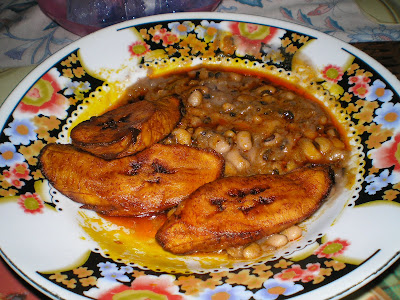
Here is a pic from my first trip to Ghana of fried plantains and bean sauce...yum!!!
My eating habits were so out of sorts while in country that it almost seems odd to return to the standard 3 meals a-day routine that we have here in the states. I have to say that I am missing some of the Ghanian foods that I have grown to love (jollof, fufu with palm nut soup, and fried plantains to name a few) not to mention the fact that I did not have to cook any of these things while I was away. I realize that my son has probably been missing these foods since he came to the US as well, and while I have prepared a few Ghanaian dishes over the past two years, maybe I need to make more of an effort to incorporate Ghanaian dishes into our weekly meal plan. One of our new OT students is Ghanaian (born in US) and said that you can microwave fufu using the instant powder; that sounds much more feasible to me than pounding the cassava myself! I also found this great site which provides recipes for lots of my favorite Ghanaian dishes. For people who read this blog and will be staying in the Accra region there are several restaurants in the city of Adabraca that I would recommend: The White Bell, the restaurant at the Niagara hotel (Lebanese), Paloma, and the restaurant at the Hotel President.
Here is a pic from my first trip to Ghana of fried plantains and bean sauce...yum!!!

Wednesday, June 3, 2009
Starting with Service
If I have been of service, if I have glimpsed more of the nature and essence of ultimate good, if I am inspired to reach wider horizons of thought and action, if I am at peace with myself, it has been a successful day.
-Alex Noble
Previous VCU groups that have worked in Ghana have spent the majority of their trip doing service projects with Sovereign Global Missions; primarily working on clearning the grounds and literally building the child development center in the village of Adoteimen. I thought from the beginning that service should be part of our trip, but I wanted also to make sure that this experience was more of a course/learning experience than purely a service trip. So we decided to spend the first two days in Ghana painting the school/child development center at the SGM complex. Under the guidance of professional painters from the town, we were able to get 1-2 coats on both the inside and outside surfaces of the school. Now, I have to say that what sticks in my mind most about the experience was how HOT it was and how I don't think I have ever been quite that dirty in my life! But, I also think that working with the painters and becoming a part of the history of the development of this center was one of the most personally rewarding experiences of the trip. I also think that this initial work helped our group to bond and work together as a team in an area unrelated to OT. I hope that future groups of students can continue to be a part of the development of this center and I will be sure to include service work into future trips. Here are some pics of the center and our painting team:

The Center (Before)

Our Team

One of our Professional Leaders

The Occasional Interference


Hard at Work

The Center (after)
-Alex Noble
Previous VCU groups that have worked in Ghana have spent the majority of their trip doing service projects with Sovereign Global Missions; primarily working on clearning the grounds and literally building the child development center in the village of Adoteimen. I thought from the beginning that service should be part of our trip, but I wanted also to make sure that this experience was more of a course/learning experience than purely a service trip. So we decided to spend the first two days in Ghana painting the school/child development center at the SGM complex. Under the guidance of professional painters from the town, we were able to get 1-2 coats on both the inside and outside surfaces of the school. Now, I have to say that what sticks in my mind most about the experience was how HOT it was and how I don't think I have ever been quite that dirty in my life! But, I also think that working with the painters and becoming a part of the history of the development of this center was one of the most personally rewarding experiences of the trip. I also think that this initial work helped our group to bond and work together as a team in an area unrelated to OT. I hope that future groups of students can continue to be a part of the development of this center and I will be sure to include service work into future trips. Here are some pics of the center and our painting team:

The Center (Before)

Our Team

One of our Professional Leaders

The Occasional Interference


Hard at Work

The Center (after)
Friday, May 29, 2009
Quick Update
Well the trip is almost over and this is the first time I have had a chance to sit down and post; that about sums up how busy we have been! In brief, we have painted a school, worked with children with and without disabilities, fed and provided first aid to street children, talked about disability culture with people with and without disabilities, given an inservice on how to adapt self-care, school and play materials for children with "special needs" and I even made a sock aid out of an old water bottle. Everyone in the group is healthy albiet a bit worn out. We will be enjoying a much deserved day at the beach tomorrow along with a bit more shopping at the crafts market. The computer here does not like my flash drive so I cannot post any pics but we will all have lots to share once we get back. Here's hoping for safe and easy travels on Monday and a smooth transition back to western culture so I can be ready to teach on the 3rd! Just in case I am still running on Ghana time when I get back our group came up with a translation sheet:
5 minutes= 15-20 minutes
10 minutes = 45 minutes
I am there= 20 minutes
I am ready, I am bringing it, or I will come = ~30 minutes
I'll be right back or I am just going to the next villiage= 45 minutes-1 hour
I am in the traffic = 10 minutes- 2 hours
I am fixing the car= you should probably take a taxi
It is finished= never
Wow, you've just gotta love Ghana!
5 minutes= 15-20 minutes
10 minutes = 45 minutes
I am there= 20 minutes
I am ready, I am bringing it, or I will come = ~30 minutes
I'll be right back or I am just going to the next villiage= 45 minutes-1 hour
I am in the traffic = 10 minutes- 2 hours
I am fixing the car= you should probably take a taxi
It is finished= never
Wow, you've just gotta love Ghana!
Monday, May 18, 2009
In less than 24 hours...
In less than 24 hours we will be on our way to Ghana to start this little adventure. Yes, I am a little anxious but mostly I am just very excited to be back in the country. I can't wait to buy my first loaf of sweet bread and juicy pineapple that you eat with your fingers. I am actually looking forward to hearing the morning sounds of Ghana, the chickens and the call to prayer. I am excited to see old friends and make new friends. Most of all I am excited to see Ghana through the eyes of my students, to watch how the country affects them. I'm sure we will all be challenged in ways that you cannot be wholly prepared for, but I am confident that this will be a wonderful experience. Ghana, here we come!
Thursday, May 7, 2009
Did I mention that we collected 500 POUNDS of Books???
So our service project for this trip was to collect (and deliver) books to send to Sovereign Global Missions for their library and to build shelves for the library once we were in country. The OT honor society, Phi Theta Epsilon, raised over $800 to pay for shipping costs and materials to build the shelves. The students going on the trip then went to work collecting books in around VCU and in the Richmond community. And Yes! when we were all finished we had 30 (fairly large) boxes of books, approximately 500 pounds worth.
It was quite an event sorting the books, packing the boxes, and wrapping the boxes for shiping. The students worked hard though (with pizza as an incentive!) and we managed to get everything packed and ready to go in about 2 hours.
While I know the books came from many sources, I would like to thank the parents and teachers at Lynwood Holton Elementary school, members of the Ginter Park United Methodist Church, the students, staff and faculty at VCU, and the staff and customers at Mango Hair Salon in Richmond who donated so many books to our cause.
Here are some pictures of our book boxing party:


It was quite an event sorting the books, packing the boxes, and wrapping the boxes for shiping. The students worked hard though (with pizza as an incentive!) and we managed to get everything packed and ready to go in about 2 hours.
While I know the books came from many sources, I would like to thank the parents and teachers at Lynwood Holton Elementary school, members of the Ginter Park United Methodist Church, the students, staff and faculty at VCU, and the staff and customers at Mango Hair Salon in Richmond who donated so many books to our cause.
Here are some pictures of our book boxing party:


Subscribe to:
Posts (Atom)


